Pages

Showing posts with label Eurozone. Show all posts

Tuesday, July 14, 2015

Prime Minister Alexis Tsipras Must Now Sell Rescue Deal To Greece, Introduce Punishing Austerity


BRUSSELS (AP) -- With members of his own party openly denouncing a preliminary rescue deal struck with Greece's European creditors, Prime Minister Alexis Tsipras must fight to cling to his government's majority after he was forced to shred election promises and introduce punishing austerity measures in exchange for the bailout.
Tsipras, who flew home Monday from grueling night-long negotiations with European leaders, will chair an executive meeting of his Syriza party early Tuesday before lawmakers begin a two-day debate on the deal - set to heap more tax hikes and spending cuts on a country already suffering through six years of recession.
The deal ensures that Greece avoids an imminent financial catastrophe and an exit from the Eurozone. But Panos Kammenos, leader of the junior partner in Tsipras' coalition government, called the bailout plan a German-led "coup."
"This deal introduced many new issues ... we cannot agree with it," Kammenos said after meeting with Tsipras.
Other Greeks rallied Monday night outside Parliament in Athens, urging lawmakers to reject the new demands.
Around 30 out of Syriza's 149 lawmakers are likely to vote against the government. Many held private meetings late Monday.
Tsipras had to consent to a raft of austerity measures, including sales tax hikes and pension and labor reforms - measures he had campaigned vociferously against over the last five years of Greece's financial crisis.
Since his election in January, the youthful Tsipras has faced intense pressure to backpedal on many of his promises to Greece's exhausted electorate. Finally, faced Sunday by the leaders of the 18 other nations that share the euro and the knowledge that Greek banks were just days away from running out of money, the moment came when he couldn't resist any more.
A series of supposed red lines vanished, including objections to tight international oversight of Greece's economy, continued involvement by the International Monetary Fund in Greece's bailout program and cuts to pensions.
The result of marathon negotiations emerged Monday: about 85 billion euros ($95.1 billion) in loans and financial support for Greece over three years that will preserve its membership in the euro, shore up its banks and allow a modicum of stability to return to the battered Greek economy.
Creditors have also dangled the carrot of a possible future debt restructuring in the event of a smooth bailout.
"We managed to avoid the most extreme measures," Tsipras said.
But in many cases, ordinary Greeks now face tougher measures than those they voted down in a nationwide referendum a little over a week ago.
Syriza's Left Platform, a group of traditionalists in Tsipras' own party, swiftly denounced the agreement as the "worst deal possible ... (one) that maintains the country's status: a debt colony under a German-run European Union."
Experts were divided over the result.
"It was the best deal the Greeks could get," says Jacob Kirkegaard, a senior fellow at the Peterson Institute for International Economics. "They did not do too badly given the terrible, terrible, disastrous starting point the current government put them in."
But Ashoka Mody, visiting professor of international finance at Princeton University, says the deal just repeats policies that have already failed.
"The economics of this program have been set up for failure," he told The Associated Press. "In three years, if this program is implemented, the Greek economy will be 10 percent smaller than it was and the debt burden will be higher."
In many ways, Tsipras' hard work begins now. As part of the deal, his government has to get the Greek Parliament to back a series of economic measures by Wednesday that creditors are demanding. And in the weeks to come, Greece will have to make further changes to its economy, such as opening to competition industries like energy that have long been protected.
"Trust needs to be rebuilt," said German Chancellor Angela Merkel, adding that with the deal "Greece has a chance to return to the path of growth."
Passage of the new measures appears assured, since Greece's opposition parties have pledged to support Tsipras' deal. But dissent within the ruling Syriza party is threatening his coalition, raising the prospect of some sort of national unity government or an early election later this year.
Greece needs another bailout, its third in five years, to cope with its mountain of debt and get its economy back on track after a six-year retreat that evokes memories of the 1930s' Great Depression in the U.S. The Greek economy has been pushed to the brink of collapse - banks have been shut down for two weeks, and restrictions limit withdrawals to a paltry 60 euros ($67) per day and normal business has almost ground to a halt.
When the Greek banks eventually reopen, they will most likely have to depend on more emergency credit from the European Central Bank.
Indications are that the ECB won't sanction further help until the Greek parliament passes the first set of creditor demands on Wednesday. And even if the ECB does start raising its emergency liquidity allowance, Greek capital controls are expected to remain for many months more.
"This agreement pulls Greece back from the brink of economic chaos but remains far from ensuring its long-term economic viability within the eurozone," says Eswar Prasad, a professor of trade policy at Cornell University.
Greece has other financing needs beyond its banks. On July 20, it has to make a 4.2 billion-euro ($4.6 billion) debt repayment to the ECB. It's also in arrears on about 1.5 billion euros owed to the IMF. Since its bailout program is not going to be in place by then - Jeroen Dijsselbloem, the eurozone's top official, estimated that would take about four weeks - Greece will need some further help.
Dijsselbloem said finance ministers were trying to figure out how to get Athens some bridge financing but warned they had "yet to find the golden key to solve this issue."
If Greece meets all of the requirements spelled out in Monday's agreement, the country will get a three-year rescue program and the commitment to restructure its debt, which is unsustainably high at around 320 billion euros ($352 billion), or around 180 percent of its annual GDP.
Since 2010, Greece has received two bailouts totaling 240 billion euros ($268 billion) in return for deep spending cuts, tax increases and reforms agreed to by successive Greek governments. Although the country's budget deficit has fallen sharply, its public debt burden has increased as the Greek economy has shrunk by a quarter.
Ordinary Greeks seemed relieved their country was not facing a chaotic exit from the euro.
Kostas Lambos, a retiree in Athens, said things would be "difficult in the beginning" but people had to understand the severity of the situation.
"This was a necessary step for the country to emerge from the dead ends that had been created in the last few years," he said.
---
Elena Becatoros and Derek Gatopoulos in Athens, Greece; Raf Casert and Menelaos Hadjicostis in Brussels, and Paul Wiseman in Washington contributed to this story.

Monday, July 13, 2015

Euro Zone Leaders Reach Agreement To Rescue Greece

VIDEO UNAVAILABLE DUE TO LOCATION
We're sorry, but the video you are trying to watch cannot be viewed from your current location.


Euro zone leaders clinched a deal with Greece on Monday to negotiate a third bailout to keep the near-bankrupt country in the euro zone after a whole night of haggling at an emergency summit, European Council President Donald Tusk announced on Twitter.

However, the terms imposed by international lenders led by Germany may put more pressure on leftist Prime Minister Alexis Tsipras, fracture the government and cause an outcry in Greece.
If the summit had failed, Greece would have been staring into an economic abyss with its shuttered banks on the brink of collapse and the prospect of having to print a parallel currency and in time, exit the European monetary union.
"The agreement was laborious, but it has been concluded. There is no Grexit," European Commission President Jean-Claude Juncker told a news conference after 17 hours of bargaining.
He dismissed suggestions that Tsipras had been humiliated by accepting far-reaching, German-inspired terms he long promised to resist.
"In this compromise, there are no winners and no losers," Juncker said. "I don't think the Greek people have been humiliated, nor that the other Europeans have lost face. It is a typical European arrangement."
Tsipras himself, elected five months ago to end five years of suffocating austerity, insisted he and his team "fought a tough battle" but had to make difficult decisions.
Instead, he won conditional agreement to receive a possible $95.29 billion over three years, along with an assurance that euro zone finance ministers would start within hours discussing ways to bridge a funding gap for Greece until a bailout - subject to parliamentary approvals - is finally ready.
German Chancellor Angela Merkel said she could recommend "with full confidence" that the Bundestag authorize the opening of loan negotiations with Athens once the Greek parliament has approved the entire program and enacted the first laws.
Asked whether the tough conditions imposed on a desperate Greece were not similar to the 1919 Versailles treaty that forced crushing reparations on a defeated Germany after World War One, she said: "I won't take part in historical comparisons, especially when I didn't make them myself."


COMPROMISE
EU officials said Tsipras finally accepted a compromise on German-led demands for the sequestration of Greek state assets worth 50 billion euros - including recapitalized banks - in a trust fund beyond government reach, to be sold off primarily to pay down debt. In a gesture to Greece, some 12.5 billion euros of the proceeds would go to investment inGreece, Merkel said.
The Greek leader had to drop his resistance to a full role for the International Monetary Fund in a proposed 86 billion euro bailout, which Merkel has declared essential to win parliamentary backing in Berlin.
In a sign of how hard it may be for Tsipras to convince his own Syriza party to accept the deal, Labor Minister Panos Skourletis said the terms were unviable and would lead to new elections this year.
As the hours ticked away overnight, most of the leaders were forced to cool their heels, playing computer games or taking a nap in their delegation offices while Tusk and the leaders ofGermany, France and Greece met several times privately to try to cut through the final knots.
Tsipras will now have to rush swathes of legislation through parliament this week to convince his 18 partners to release bridging funds to avert a state bankruptcy and just to begin negotiations on a three-year loan.
Six sweeping measures including spending cuts, tax hikes and pension reforms must be enacted by Wednesday night and the entire package endorsed by parliament before talks can start, the leaders decided.
In almost the only concession after imposing a tough set of terms on Tsipras, Germanydropped a proposal to make Greece take a "time-out" from the euro zone that many said resembled a forced ejection if it failed to meet the conditions.
Tsipras had said on arrival in Brussels on Sunday he wanted "another honest compromise" to keep Europe united. Instead, he was subjected to a 17-hour browbeating by leaders furious that he had spurned their previous bailout offer on more favorable terms in June and held a referendum last week to reject it.
Only France and Italy worked to try to soften the terms being imposed on Greece.
One senior EU official calculated the cost to the Greek state of the last two weeks of political and economic turmoil at 25 to 30 billion euros.

HARD BARGAIN
Merkel, whose country is the biggest contributor to euro zone bailouts, said from the start that she would drive a hard bargain against a backdrop of mounting opposition at home to more aid for Greece.
If Greece meets the conditions, the German parliament would meet on Thursday to mandate Merkel and Finance Minister Wolfgang Schaeuble to open the talks on a new loan. Then Eurogroup finance ministers could formally launch the negotiations.
Perhaps the toughest condition for Tsipras to swallow was Germany's insistence that Greek state assets worth up to 50 billion euros be placed in a trust fund beyond government reach to be sold off with proceeds going directly to pay down debt.
Berlin initially wanted to use a structure in Luxembourg managed by its own national development bank, KfW, but diplomats said it was flexible on the location.
One diplomat said that was tantamount to turning Greece into a "German protectorate", stripping it of more sovereignty.
But Merkel declared the matter a "red line" for Germany.
For his part, Tsipras demanded a stronger commitment by the creditors to restructure Greek debt to make it sustainable in the medium-term. That could be his only hope of selling such a deeply unpalatable package to his own supporters and the public.
An EU official said several options were under consideration to give Greece bridging funds once it passed the laws, but no final decision was taken.
They included releasing European Central Bank profits on Greek bonds, tapping an emergency fund run by the European Commission, or bilateral loans from friendly countries such asFrance. Two French sources denied any bridging loan was planned.
Finance ministers said Greece needed 7 billion euros of funding by July 20, when it must make a crucial bond redemption to the ECB, and a total of 12 billion euros by mid-August when another ECB payment falls due.
Some diplomats questioned whether it was feasible to rush the package through the Greek parliament in just three days. Tsipras is set to sack ministers who did not support his negotiating position in a vote last Friday and make dissident lawmakers in his Syriza party resign their seats, people close to the government said.

Saturday, July 11, 2015

Greece Struggles At Bailout Talks To Persuade Creditors Over Reforms

BRUSSELS (AP) -- Bailout discussions between the Greek finance minister and his skeptical counterparts in the 19-country eurozone will resume Sunday after breaking up following more than eight hours of talks without any apparent breakthrough that will secure the country's future in the euro.
On leaving the meeting, Jeroen Dijsselbloem, the eurozone's top official, said there had been "in-depth" discussions, and highlighted the issue of "trust."
The talks will resume at 11 a.m. local time (0900 GMT), just a few hours before European leaders are meant to descend on Brussels for a summit that has been billed at various points over the past week as Greece's last chance to convince creditors that it deserves more financial help.
Dijsselbloem said the discussions were "very difficult but work is still in progress."
greece
Greece's finance minister, Euclid Tsakalotos is clearly struggling to convince skeptical creditors that the Greek government can be trusted to deliver on its reform promises in exchange for a financial rescue package securing the country's future in the euro.
The pressure has been on Greece all day even after the Greek parliament passed a harsh austerity package that it hopes will lead to a three-year bailout. Over and over, finance ministers and top officials of the eurozone said the same thing as they arrived for the key meeting in Brussels on Greece's bailout proposals - we don't fully trust you to make good on your promises.
Greece's left-wing Syriza government, they said, needed to do a lot more than just publish a 13-page plan of reform commitments before they could sign off on another multibillion-euro bailout deal that would keep the country afloat and prevent its exit from the euro.
A European official at the talks said creditors want "more specific and binding commitments" from the Greek government.
The official, who spoke on condition of anonymity because he's not authorized to talk publicly, says there's a general feeling in the room that the Greek proposals are "too little, too late" and as such, more proof of the government's commitment to follow through is required. The official said those pledges don't "necessarily have to be austerity measures."
greece
That sentiment echoes much of the language in the run-up to the meeting.
"We are still a long way out, both on the issue of content as on the tougher issue of trust," Jeroen Dijsselbloem, the eurozone's top official, said on his arrival at the meeting. "On paper it is not good enough yet - and even if it is good on paper, then we still have the question: will it really happen?"
Greece is running out of time to convince its creditors. A Sunday summit of European Union leaders could be its last chance to prevent the collapse of the banking sector and an inevitable exit from the euro currency.
greece
Greece's banks have been shuttered for the better part of two weeks and daily withdrawals from ATMs have been limited to a paltry 60 euros. The economy is in freefall and the country faces a raft of big debt repayments.
Early Saturday, Greek Prime Minister Alexis Tsipras cleared one hurdle. Lawmakers in the Greek parliament overwhelmingly backed a package of economic reforms and further austerity measures, in the hope that it will convince its European partners to back a third bailout of the country. Greece has made a request to Europe's bailout fund for a 53.5 billion-euro ($59.5 billion) 3-year financial package.
Still, the measures proposed, which include changes long-demanded by creditors, such as changes to pensions and sales taxes, don't appear to be enough, just yet. Following months of deteriorating relations, creditors are demanding firm legislative action to back up the proposals.
greece
Earlier, German Finance Minister Wolfgang Schaeuble, who has taken a hard line on Greece over recent months, said the Greek government will have to do a lot more than just say it wants to reform if it's going to get more money.
"We will definitely not be able to rely on promises," he said. "We are determined to not make calculations that everyone knows one cannot believe in."
Schaeuble was clear in who he blamed for current crisis. He put that firmly on the shoulders of the radical left Syriza government that was elected in January on an anti-austerity prescription. The "hopeful" economic situation regarding Greece at the end of last year has been "destroyed by the last months," said Schaeuble who anticipated an "extraordinarily difficult" meeting.
The German finance minister was at the center of a report in Germany's Frankfurter Allgemeine Sonntagszeitung that he has proposed a temporary, five-year euro exit for Greece as a way out of the crisis. However, Theodoros Mihopoulos who heads Greek Prime Minister Alexis Tsipras' office, said in a tweet that the report "is completely denied."
greece
Finland is perhaps taking the hardest line of all. Reports out of the country said the coalition government was balking at further assistance for Greece.
The eurozone ministers have to give their blessing to Greece's bailout request to the European Stability Mechanism. Traditionally, eurozone ministers agree by mutual consensus. The task facing the new Greek finance minister, Euclid Tsakalotos, is to convince his skeptical counterparts that Greece deserves another bailout, which would be its third in five years.
Greece has received bailouts totaling 240 billion euros in return for deep spending cuts, tax increases and reforms from successive governments. Though the country's annual budget deficit has come down dramatically, Greece's debt burden has increased as the economy has shrunk by a quarter.
greece
The Greek government has made some form of debt relief a key priority and will hope that a comprehensive solution will involve European creditors at least agreeing to delayed repayments or lower interest rates.
French Finance Minister Michel Sapin said Europe wants to hear the nitty-gritty around Greece's proposals: "How are you going to do it? At what moment are you doing to do it? At what tempo are you going to do it."
greece
___
Menelaos Hadjicostis in Brussels contributed to this story.

Wednesday, July 8, 2015

Hillary Clinton Urges Europe To Keep Greece In Eurozone

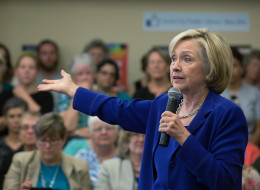
IOWA CITY, Iowa -- European leaders should “exert every effort” to forge a new bailout deal that keeps Greece in the eurozone and allows the indebted country to recover economically, Hillary Clinton said on Tuesday.
David Greedy via Getty Images
“I think it is imperative that there be an agreement worked out with Greece,” the Democratic presidential candidate said in response to a reporter's question at a campaign stop in Iowa City. “And I urge the Europeans to exert every effort to find one. Greece is a NATO ally, it is a member of the European Union. The United States has a great, active, successful Greek-American community. So I want to see a resolution.”


"Obviously at the end of the day, it is up to the Greek people to decide what they are willing to do," Clinton added. “And I hope we can see an outcome here that will actually help Greece recover and keep them in the eurozone and keep Europe united.”
While the former secretary of state did not comment directly on the results of Sunday's referendum, in which Greece overwhelmingly rejected a new austerity proposal from its international creditors, she expressed sympathy for the country's economic plight.
“I think what has happened in Greece is a tragedy,” Clinton said Tuesday, in a rare instance of taking reporters' questions on the campaign trail. “Their gross national product has dropped over 25 percent. They have youth unemployment over 50 percent. People are suffering. Pensioners are worried that they are not going to be able to afford food.”
The comments are Clinton’s first remarks on the Greek crisis since she began her presidential run. They mark something of a departure from previous statements, in which she offered less qualified support for the loans-for-austerity packages that European creditors have negotiated with Greece. In a 2011 visit to Athens while serving as secretary of state, Clinton described Europe’s insistence on fiscal austerity in Greece much more favorably, calling it “chemotherapy” that will “give Greece a very strong economy going forward."
Clinton’s remarks on Tuesday echo the approach of the Obama administration, which has acknowledged the Greek people's desire for economic relief while calling on both sides to compromise and reach a resolution that keeps Greece in the eurozone. On Tuesday, President Barack Obama spoke to both German Chancellor Angela Merkeland Greek Prime Minister Alexis Tsipras to convey the United States’ desire for mutual compromise.
But Clinton’s statement distinguishes her stance from that of rival Democratic candidate Sen. Bernie Sanders (I-Vt.). In a forceful statement on Sunday, Sanders celebrated the Greek people’s rejection of the creditors’ austerity proposal through the referendum vote, explicitly supporting the Greek government against its international creditors.
“I applaud the people of Greece for saying ‘no’ to more austerity for the poor, the children, the sick and the elderly,” Sanders said. “In a world of massive wealth and income inequality Europe must support Greece's efforts to build an economy which creates more jobs and income, not more unemployment and suffering.”
None of the other three announced Democratic presidential candidates -- former Maryland Gov. Martin O’Malley, former Rhode Island Gov. Lincoln Chafee and former Virginia Sen. Jim Webb -- have yet commented publicly on the Greek debt crisis.
Samantha-Jo Roth reported from Iowa City. Daniel Marans reported from Washington.

Wednesday, July 1, 2015

Markets rally on report Greece accepts creditor terms

Eurozone stocks and peripheral bonds rallied on Wednesday, extending gains after a report that Greece was ready to accept most conditions from its international creditors in order to reach a deal over its debt crisis.
Greek Prime Minister Alexis Tsipras was prepared to accept creditors' demands for a bailout with only a few minor changes, the Financial Times said.
The FTSEurofirst 300 extended gains, up 1.5 pct, with the euro zone blue-chip Euro STOXX up 2.1 percent.
The euro trimmed losses against the dollar to trade at $1.1535, flat on the day, while against the British pound it turned higher to trade 0.4 percent higher on the day.

German 10-year yields rose 4.3 basis points to a day's high of 0.82 percent while Spanish, Italian and Portuguese equivalents fell 6-8 bps to 2.22 percent, 2.25 percent and 2.90 percent, respectively. -- REUTERS